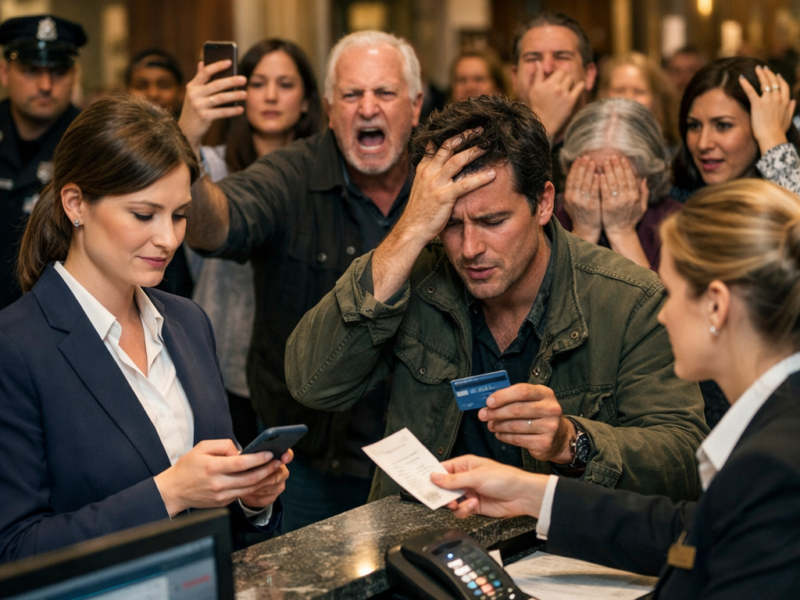
My boyfriend texted from his luxury trip: “We’re extending the vacation, send more money.” I didn’t reply. Then I packed his bags, left them with his mother. A week later, the trip was over he…
Riley Morgan sat in the break room, stirring powdered creamer into the bitter coffee she had been drinking for the last ten minutes. It was just another Monday—just another day where she would push through her tasks and go home to the apartment she had worked hard to keep her life in order. But the message on her phone changed everything.
Her boyfriend, Damon, was on yet another “luxury trip” with his friends, this time in St. Barts, far from Tampa. As usual, he needed money. But this time, there was no politeness. No “please” or “can you” or even the usual “I’m so sorry to bother you.” No, Damon had moved past asking, and now he was demanding.
Damon: We’re extending the vacation. Send more money.

The beach emoji at the end of the message did nothing to soften the sting. Riley stared at the screen, frozen. Her heart sank, but it wasn’t the kind of feeling that came with a deep emotional cut. It was something colder, sharper, more final. Riley had been here before, too many times before. Damon had a pattern, a cycle of neediness that always seemed to take more than it gave.
Riley had been supporting Damon for the past year. The details had started small at first—just a few hundred dollars for “urgent” bills or “unexpected” expenses—but soon the amounts had grown larger. He was “between opportunities,” as he liked to say, which meant he had endless free time for the gym, for nightlife, and for jet-setting on trips to places Riley could never afford. Each request for money had come with an excuse, a reason why he couldn’t handle things on his own. She had made the mistake of paying without questioning it, of giving without expecting anything in return. She had grown accustomed to it. That’s how relationships worked, right?
At least, that’s what Riley told herself. But the message today felt different. This wasn’t just Damon being irresponsible or lazy—it was entitlement, pure and simple. It wasn’t a request; it was an order. And it was the last straw.
Riley didn’t respond to the message. She put the phone down, face down, and went back to her desk. She kept working as if her world hadn’t just been cracked wide open. It wasn’t the first time Damon had asked for money while on vacation, but this time, something in Riley snapped. It wasn’t just the money. It wasn’t the way he had used her. It was the fact that he expected to continue using her, without even the pretense of gratitude. It was the fact that he had no intention of ever changing, and Riley had been letting him get away with it.
Later that day, after work, Riley went home. The apartment was quiet—too quiet. It was the kind of quiet that made her feel lonely, even though Damon was supposed to be there. She opened the door to the apartment they had shared for the past six months, the place where she had rearranged everything to make room for him. The apartment had always been a symbol of stability for her—an anchor in a chaotic world. But now, it felt more like a prison.
Damon’s shoes were still by the door, his cologne still on the bathroom counter. He had left everything as though he expected it to be there when he came back. But Riley had had enough.
She moved quickly, not with anger, but with a kind of detached determination. She packed Damon’s things into boxes—his designer shirts, his sneakers, his laptop, and all the things that had made him feel important—each item wrapped with the care of a return. She labeled the boxes with a simple marker: DAMON.
She didn’t waste time feeling sorry for him. She didn’t cry, didn’t rage-clean, didn’t throw anything in a fit of frustration. She simply packed his things with the same efficiency she had used to build a life without him.
When the bags were packed and the apartment stripped of all the evidence of his stay, Riley drove across town to Damon’s mother’s house. Sharon Pike opened the door in a robe, looking confused when she saw Riley standing there, holding the bags.
“Riley?” Sharon asked, her eyes dropping to the stack of bags. “What is this?”
Riley didn’t hesitate. She wasn’t here for an explanation. She had already made her decision. “Damon’s things,” Riley said calmly. “He’s extending his vacation. So he won’t be needing my apartment anymore.”
Sharon’s face tightened. She looked like she wanted to defend her son automatically, but she didn’t. She had heard Damon’s excuses before. All mothers had.
“He said you’d send money,” Sharon muttered, clearly struggling to understand what was happening.
Riley gave her a small, sad smile. “He told you that?”
Sharon didn’t answer.
“I’m done,” Riley said, her voice firm. “Please make sure he gets these. And tell him I won’t be replying anymore.”
Riley turned and walked away, leaving Sharon to process the end of something she had probably feared for a long time.
The next week, Riley went about her life like a woman who had finally stepped out of the shadows of someone else’s expectations. She didn’t call Damon, didn’t text him back. She didn’t chase him. She didn’t ask for explanations. She simply moved forward, step by step, leaving him behind in the past where he belonged.
But Damon wasn’t done. Damon didn’t take rejection lightly. And he had no intention of letting Riley slip away that easily.
It didn’t take long for Damon to start making his presence known, even after Riley had packed his bags and sent him off to his mother’s house. He couldn’t simply let things go. It was never in his nature to accept rejection, especially when it meant losing someone who had been a steady source of support.
The day after Riley dropped his bags off at Sharon’s, her phone began to ring. The first call came before 9 a.m. The number was familiar, the area code one Riley had seen dozens of times. It was Damon’s.
She stared at the phone for a long moment before hitting “decline.” Then she set it back down on the kitchen counter and finished her coffee.
It was quiet at first. The kind of silence that stretches after a storm, when everything feels too still to be real. Riley moved through her day, as usual—working at her office, answering emails, staying focused on her responsibilities. But the tension was there, lingering like smoke in the air. Every time her phone buzzed, she checked the screen. Every time the doorbell rang, her heart skipped.
The messages came next.
Damon: Riley, why are you ignoring me?
Riley read the text but didn’t respond. Instead, she muted the conversation and put her phone down.
The phone kept buzzing. Damon didn’t let up. The messages became more frequent, more desperate, more demanding.
Damon: You can’t just do this to me.
Damon: I need you to send more money. My trip isn’t over yet.
Damon: I’ll make it up to you. I’m sorry for everything. Just give me a chance.
Riley kept her cool. She had done the hard part. She had already made the decision to let him go. She wasn’t going to give in now. The truth was, Damon hadn’t just asked for money. He had demanded it. And the moment Riley had given in, it had led her here—having to pick up the pieces of a broken relationship that had been built on entitlement and manipulation.
That night, after another exhausting day at work, Riley opened her door to find a pile of messages from Damon’s friends.
“Why are you doing this?”
“Damon’s going crazy, Riley.”
“Can’t you at least talk to him? He’s really upset.”
They all had one thing in common: they had no intention of holding Damon accountable. They were just trying to get him what he wanted. They didn’t care if Riley had been the one shouldering the burden for the past year.
She replied to one of them, the one who had been the most persistent.
Me: If you’re worried, you can send him money.
Her phone went silent for a long time after that. The responses were few and far between, as they clearly realized the joke was over.
Damon had worn out his welcome in more ways than one. He had exhausted Riley’s patience, her bank account, and her love. Now, he was just a man she refused to acknowledge.
The following days were filled with more of the same. Damon called her incessantly, leaving voicemail after voicemail, each one more frantic than the last.
“Babe, this isn’t funny anymore,” he said in one. “You can’t just leave me like this. You know I need your help.”
Another call came in that evening, this time with a twist. The message was oddly calm.
“Riley, I’m on my way to the airport. I’m sorry. I messed up. I’ll make it right when I get back. Please, just talk to me.”
Riley didn’t reply. There was nothing to say. Damon had tried every tactic—guilt, anger, and now even the barest apology. But she knew it was all manipulation, every last word. He wasn’t truly sorry. He was sorry he didn’t have access to her wallet anymore.
At lunch the next day, Riley sat at her desk, feeling strangely detached from it all. She had built her life around being self-sufficient. She had taken pride in the fact that she could rely on herself, her own work, her own ambition. And yet, she had allowed Damon to erode her sense of worth. She had let his words and his needs take over, and it had cost her more than money—it had cost her dignity.
But now she was done.
It was time to take the next step.
She began to change the locks on everything.
At first, it was a small thing. She updated the access code to her apartment. She called the leasing office to make sure no one could just waltz into her home. Then she started changing passwords—banking, email, and even the streaming services she had shared with Damon. It was simple, but the act of it felt like cutting off the last threads that still tethered her to him.
She wasn’t going to let Damon back in. Not physically, not emotionally, not financially. If he needed her help, it was only because he had learned nothing from the past. She was no longer an ATM for his whims. She was no longer his safety net.
On day four, Sharon texted.
Sharon: He’s upset. Can you at least talk to him?
Riley sat at her desk, staring at the text, wondering if Sharon was trying to guilt her into picking up the pieces. She thought about everything she had gone through, all the moments when she had supported Damon, when she had made excuses for him, when she had forgiven him for behavior that now felt like betrayal.
Me: He can talk when he’s ready to take responsibility.
That was it. No emojis. No softness. Just the hard truth.
Day six brought something different.
Damon tried one more tactic—guilt.
It came in the form of a sunset picture. A stunning, golden image of the ocean, with the caption:
Damon: Look what you’re missing. If you loved me, you’d help me enjoy this.
Riley couldn’t help but laugh at that one. It was the final straw. The attempt to manipulate her love was laughable now. She forwarded the message to herself and filed it away. She knew Damon would rewrite history in his own mind eventually, and she wanted to keep the receipts. Keeping things real meant keeping the truth close.
It was the sixth day after Riley had packed Damon’s things and sent him off to his mother’s house when the pattern finally became undeniable. Damon wasn’t just angry anymore. He wasn’t even begging for money. He was desperate to control the narrative, to twist the story in his favor, as if he could manipulate his way back into her life with the right words and the right tactics.
But Riley was done.
Day six had begun with the sunset photo, the one that tried to pull at Riley’s heartstrings. She had laughed at it, a real laugh, one that felt good and bitter all at once. The image of Damon lounging in some tropical paradise, taking photos of his vacation, had almost become the symbol of what their relationship had been. He had always wanted to enjoy the rewards without doing any of the work. He was selfish, entitled, and entitled people rarely change unless they hit rock bottom.
And Damon had hit his.
The next day, it wasn’t just Damon who reached out. His friends, the ones who had stayed quiet up until now, started messaging her one by one. Each text felt like an echo of Damon’s demands, but this time, they were coming from others who had enabled him in the past.
“Damon’s really stressed,” one text said.
“Why are you being so cold?” another asked.
“He’s just having fun. You should talk to him,” came the third.
The weight of it all felt suffocating. She wasn’t surprised. Damon had always surrounded himself with people who didn’t challenge him, people who let him take without consequence, people who kept his world spinning even when he didn’t deserve it. They were offering no support, no understanding, only the same tired excuses.
Riley, though, was no longer swayed by excuses.
She opened the message from Damon’s friend, Chad. Chad had always been the one who laughed at Damon’s “problems,” who joked about how Damon “worked hard to look like he was living the dream.” If there was one person who enabled Damon’s behavior, it was Chad. He was the type of friend who had no boundaries of his own, and Riley could feel his fingerprints all over Damon’s actions.
So she replied.
Me: If you’re worried, you can send him money.
The silence after that was almost louder than the texts had been. Riley waited for a response, but none came. She knew they wouldn’t send money. Not because they didn’t care about Damon, but because they didn’t care about Riley.
Damon’s behavior was becoming more desperate with every passing hour, but Riley was resolute. She had already drawn her line in the sand, and she wasn’t going to erase it now.
The evening of Day seven arrived with its usual tension, but this time, it wasn’t a text that set Riley’s heart racing. It was a ring at the doorbell, the sharp chime that made Riley freeze in place.
She glanced at the door, then at the time. 10:26 p.m.
Her heart dropped into her stomach. She already knew who it was.
Damon.
She had been waiting for this, but the reality of him showing up on her doorstep still felt like a punch to the gut. He hadn’t learned anything. He hadn’t taken responsibility. He still thought he could waltz back into her life, using guilt, manipulation, and charm to get what he wanted.
Riley didn’t move. She didn’t rush to answer the door. Instead, she stood still, listening to the sound of Damon’s footsteps in the hallway, then the loud knocking on her door.
“Riley!” Damon shouted. “Open up!”
She didn’t budge. She stood where she was, at the other side of the door, waiting.
“You can’t just lock me out!” he yelled, his voice growing more frantic. “Riley, please!”
His desperation was almost comical, if it weren’t so sad. The man who had once been so confident, so entitled, was now reduced to this—a pleading man with nowhere else to turn.
“I can,” Riley replied, her voice steady. “It’s my lease.”
There was a moment of silence on the other side of the door, then a harsh bang as Damon slammed his fist against the door. His tone shifted now, softer, almost pleading.
“You can’t do this to me. Where am I supposed to go?”
Riley hesitated, letting the silence stretch for a few seconds. She wanted him to hear the weight of her words. She wanted him to understand what he had done, what he had become. She wanted him to feel the sting of his own actions.
“The same place you told me to send money,” she said, her voice calm but cutting. “Your mom’s.”
For the first time, there was a hitch in Damon’s voice. It cracked, like he was trying to hold it together but couldn’t.
“Riley, please,” he begged. “I’m sorry. I’ll pay you back. I just needed—”
“You needed a sponsor,” Riley cut him off, her voice steady and final. “Not a girlfriend.”
There was silence again, this time longer, heavier. Damon didn’t know how to respond. He had spent their entire relationship treating Riley like a resource to be used, a source of endless support. He had never been asked to take responsibility for his actions. But now, with his options running out, he was facing a truth he couldn’t deny.
The door remained closed. Riley didn’t open it. She wasn’t going to let him in—not physically, not emotionally.
The next morning, Riley woke up with a strange mix of emotions. There was relief, yes. She had finally done what she had needed to do. But there was also something else—something unexpected. Grief. Not because she missed Damon, but because she missed the person she had once been before he came into her life. She had lost herself in trying to keep him afloat, in making excuses for him, in believing that she could fix him.
But that was over now. And though the grief still lingered, it was mixed with something else: freedom.
Sharon called later that afternoon.
“He came home last night,” Sharon said, her voice low. “He’s on my couch. He’s… not handling it well.”
Riley didn’t gloat. She didn’t feel smug. There was no satisfaction in this for her. This was a consequence Damon had to face. She didn’t want to make things worse, but she wasn’t going to apologize for taking care of herself.
“He’ll handle it,” Riley said simply, her voice calm.
Sharon sighed on the other end of the line. “Riley, he told me you abandoned him.”
Riley’s chest tightened, but she didn’t let it show. She wasn’t going to play the victim. She wasn’t going to buy into the narrative Damon was trying to spin.
“I didn’t abandon him,” Riley replied, her voice firm. “I stopped carrying him.”
Sharon didn’t say anything after that. She knew. She knew Damon’s patterns. She knew how he had always been. And for the first time, Sharon didn’t argue.
Riley’s phone buzzed again later that evening. It was an email from Damon. She knew what it was before she even opened it. He had written an apology, one that sounded rehearsed, one that was filled with excuses. He talked about the stress he was under, about feeling insecure around successful people, about how sorry he was. He promised he would get a job and “make it right.”
But Riley didn’t feel anything reading it. She didn’t feel sympathy or anger or even a flicker of hope. It was just words—empty words from a man who had learned nothing.
She forwarded it to her friend Talia, who worked in HR, and asked for help drafting a response. Talia had been through her own fair share of relationship troubles, and she understood Riley’s need for finality.
Together, they wrote a short, to-the-point message:
Damon, I wish you well. I’m ending the relationship. Do not contact me at home or work. If you need to pick up any remaining items, schedule one time through email.
That was it. There would be no debate. No back and forth. No emotional paragraphs.
Two days later, Damon tried again—this time showing up at Riley’s office lobby with flowers. He had clearly thought that the grand gesture would melt her resistance. Security had already been notified, though, and when Damon arrived, they stopped him before he could even get to the elevators. He stood in the lobby, holding the bouquet like a prop, his eyes wide with disbelief. He had no idea how to process the reality that Riley wasn’t going to cave.
Damon’s visit to Riley’s office was his last attempt to manipulate her back into his life. The flowers, the pleading look, the arrogance that still clung to him despite everything—none of it worked. Riley had already made her decision. She had drawn a line, and she wasn’t going to let him cross it again.
| Next » |